Your cart is currently empty!
Checkout is not available whilst your cart is empty—please take a look through our store and come back when you're ready to place an order.
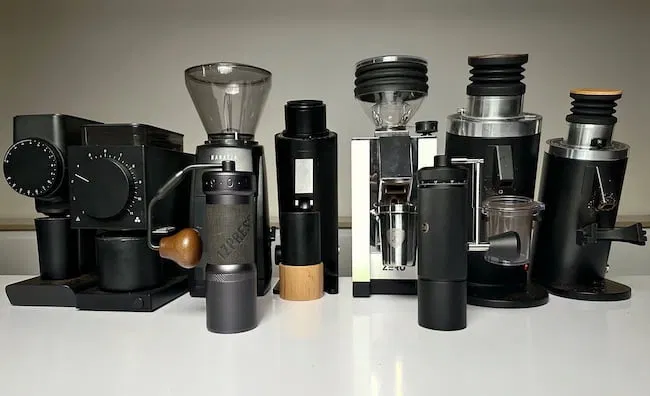
If someone tells you the most important thing in coffee is the beans, they’re only half right. Even the best specialty coffee delivers mediocre results with the wrong grind. In this coffee grind size guide you’ll find exactly which setting you need for every brewing method — and why the grinder deserves to be your very first investment.
The logic is simple: your brewer controls only time and temperature. Your grinder controls how fast water interacts with coffee — in other words, it controls extraction. And extraction is flavor.
Picture two setups: a €300 espresso machine with a €30 grinder, and a €150 machine with a €150 grinder. Nine times out of ten, the second one makes better coffee. The reason is uniformity: a cheap grinder breaks beans unevenly — some particles come out as dust, others stay coarse. The fine ones over-extract (bitterness, astringency), the coarse ones under-extract (sourness, thin body). The result? Coffee that tastes simultaneously bitter and sour — something that shouldn’t be possible, yet bad grinding achieves it.
A good grinder, by contrast, produces particles of consistent size. That means even extraction, which translates to clean flavor — you can actually taste the chocolate, the fruit, or the nuts instead of a muddy mix of bitter and sour.
The two basic kinds:
Blade grinder: Essentially a blender. A spinning blade chops beans at random. The result: dust mixed with boulders, zero repeatability. It’s the worst thing you can do to coffee — save it for spices.
Burr grinder: Two metal or ceramic surfaces crush the bean to a controlled size. Adjust the distance between them and you adjust the grind. Repeatable, uniform, reliable.
The difference isn’t theoretical. If you’re using a blade grinder right now, upgrading to even the most affordable burr grinder will be the single biggest flavor improvement you’ll ever experience in your coffee.
Among burr grinders: hand grinders deliver outstanding uniformity at a much lower price, because you’re not paying for a motor and housing. The tradeoff: you grind by hand, which takes 30–40 seconds of effort for espresso. For filter coffee, they’re an ideal solution. Electric burr grinders win on speed and convenience, but they only become truly worthwhile above a certain price point.
Every coffee bean contains hundreds of chemical compounds. Water pulls them out gradually, in a specific order:
First come the acids and fruity aromatics. Then sweetness, body, chocolate. Last come bitterness, astringency, and woody notes.
The goal is always the same: stop extraction at the sweet spot — after you’ve captured flavor and body, before you reach unpleasant bitterness.
And this is where grind size comes in:
The finest grind that exists. The coffee boils inside the water and is never filtered — you need powder so it “merges” with the liquid. Most burr grinders can’t go this fine. Traditionally, Greek coffee is ground on specialized mills. If you don’t have one, look for coffee ground specifically for ibrik.
Espresso extraction lasts only 25–30 seconds under 9 bars of pressure. To pull enough flavor in such a short time, the grind must be very fine so the contact surface with water is enormous. The adjustment here demands precision — even half a “click” on your grinder changes the flow dramatically. This is why, if espresso is your main drink, grinder quality is critical.
Slightly coarser than espresso, but finer than filter. The moka pot works at 1–2 bars of pressure — far less than espresso. If you use an espresso grind, the coffee will taste bitter and scorched. Aim for something resembling fine sea salt.
The beauty of the AeroPress is its flexibility. A medium grind with a 1:30-minute steep is the safe starting point. From there, you can experiment: finer for more intensity, coarser with a longer steep for a cleaner result. Many AeroPress champions use surprisingly coarse grinds with extended immersion.
Here the grind controls flow: too fine and water pools on top of the bed, leading to over-extraction. Too coarse and it drains in seconds, producing watery coffee. Starting point: something resembling coarse sea salt. Target brew time: 2:30–3:30 minutes for V60, 3:30–4:30 for Chemex.
One detail: Chemex needs a slightly coarser grind than V60, because its thicker filter slows the flow.
Immersion plus filtration methods. The coffee steeps in water for a set time, so the grind can be coarser than pour-over. Think coarse salt.
The French press is full immersion with no paper filter — just a metal mesh. If the grind is too fine: sludge in your cup, bitter coffee, and a plunger that’s nearly impossible to push down. Coarse grind plus a 4-minute steep gives a clean, full-bodied cup without excessive bitterness.
Extraction time here is 12–24 hours in cold water. If you grind fine, over that many hours the coffee will extract far past the sweet spot. A very coarse grind compensates for the long contact time, yielding a sweet, smooth, low-acidity result.
The chart above is a starting point, not an absolute rule. Every coffee, every grinder, and every batch of water behaves slightly differently. The real adjustment is always made by taste:
If the coffee tastes bitter or astringent: extraction has gone too far. Go one step coarser.
If the coffee tastes sour or watery: extraction is insufficient. Go one step finer.
If the coffee tastes both sour AND bitter at the same time: likely a uniformity problem — your grinder is producing both dust and boulders. If this persists regardless of setting, it may be time to upgrade your grinder.
Make one change at a time. Adjust the grind, keep everything else constant (dose, water, time), taste. Repeat. This process becomes second nature after a few days.
The short answer: right before brewing. Ground coffee starts losing aromatics within minutes — literally. This happens because grinding exponentially increases the surface area exposed to air: a whole bean has a small surface, but ground to espresso fineness it gains thousands of times more. Oxidation runs fast.
If you buy pre-ground coffee for convenience, make sure at the very least that it’s freshly roasted and in airtight packaging. But if you truly want to experience the difference a specialty coffee can make, the grinder is the move that unlocks everything.

Stories, tips and flavor – freshly served.